// Personal manifesto
Why I want AI in my brain
Between my thoughts and the world sits a bottleneck: two thumbs and a keyboard. I want it gone. This is my honest, personal answer to why I want a brain-computer interface as soon as it can be done responsibly, with all my hopes, all the numbers, and all my fears.
01
Part of me is already machine
I live with an artificial heart valve. With every single beat, a piece of technology works inside my chest to keep me alive. At night, when everything is quiet, I can hear it faintly clicking, a mechanical metronome keeping time for my life. Most people think of science fiction when they hear about merging humans and machines. I think of my own heart.
When someone tells me this merger is against nature, I answer: for me, it is the reason I wake up in the morning. Without engineering, without materials science, without surgery that joins technology and tissue, I would no longer exist. I am already a cyborg, just version 1.0. And I am far from alone in that.
Pacemakers, cochlear implants, insulin pumps, deep brain stimulation for Parkinson's: millions of people carry technology inside their bodies today, and nobody calls it a transgression. The step from repairing implants to enhancing ones is smaller than most people think: it is the same road, one step further. I want to take that step deliberately, not stumble into it in shock one day.

02
The bottleneck between mind and world
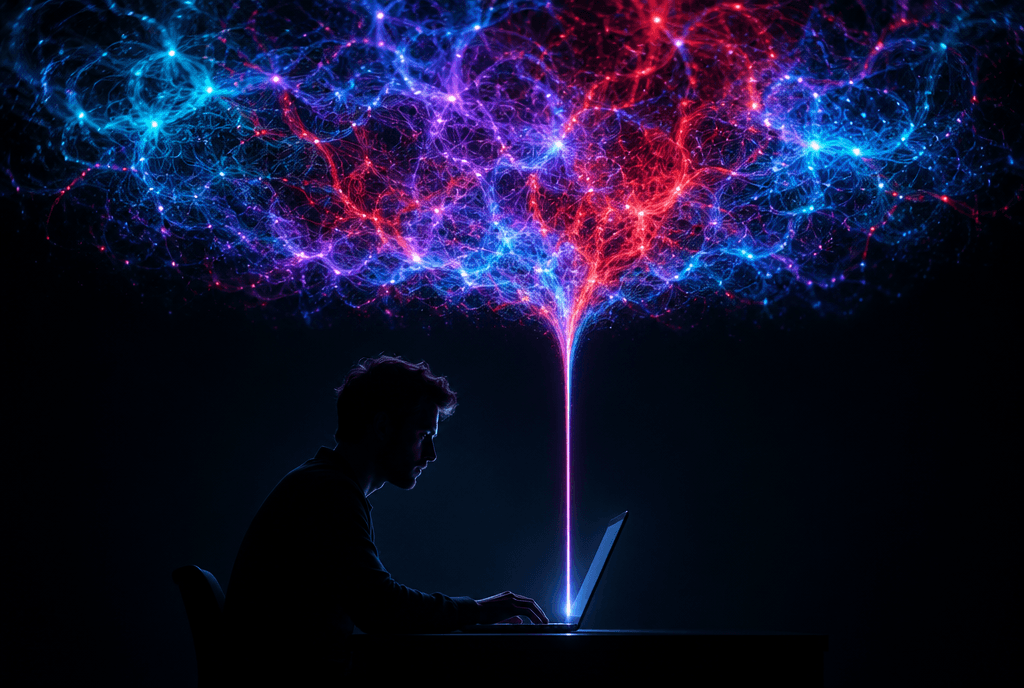
Try an experiment: think of the most complex image you know, maybe your childhood room, a face, a city at night. Your brain retrieves it in milliseconds, complete with colors, smells, emotions. Now try to describe it to someone. Suddenly you need minutes, and only a fraction will arrive. Everything we send outward, whether speaking, typing, or swiping, squeezes through a channel of an estimated few dozen bits per second. Every idea reaches the world only as lossy compression.
As a developer, I feel this bottleneck physically every day. Between the moment I see a solution complete in my head and the moment it exists in code lie hours of mechanical translation: thought to fingers, fingers to keyboard, keyboard to characters. AI assistants have already cut that gap in half in recent years: I describe what I want and the machine writes along. But I am still describing it with the bandwidth of 1875, the year the typewriter went mainstream.
To me, a brain-computer interface is first and foremost exactly that: the end of this bottleneck. Not magic, not mind reading, but widening the line between the fastest organ evolution ever built and the fastest tools we ever built. Thinking and creating move closer together until they become one.
03
What already works today: Neuralink, Synchron and the quiet revolution
This is no longer science fiction. Since January 2024, people have been living with Neuralink's N1 chip: over 1,000 electrodes, each thinner than a hair, placed into the brain by a robot. The first patient, Noland Arbaugh, is paralyzed from the neck down, and today he plays chess on a computer with nothing but his thoughts. By now, more than a dozen patients move cursors, write, and work this way.
And Neuralink is only the loudest company in an entire field. Synchron threads its Stentrode through the blood vessels to the brain without opening the skull. Research teams decode inner speech from brain signals at speeds approaching normal conversation. The BrainGate consortium has been working on these interfaces for two decades, since long before a billionaire put the topic on front pages.
The curve behind all this is the real argument. In 1998, the first human interface consisted of two electrodes. The Utah array of the 2000s had 96 channels. Neuralink's N1 has 1,024, and the next generation is aiming for a multiple of that. Anyone who sees this curve and still claims the merger of human and machine is fantasy has slept through the last 25 years.
Bandwidth is growing: electrodes per brain implant
Electrodes per implant (logarithmic scale)
04
What I concretely expect from it
First: a memory that never loses anything again. Names, conversations, everything I've read, all retrievable like a file instead of fading like a photograph. Second: learning at software speed. Today a new field costs me years. With direct access to knowledge and AI support in my head, years would become weeks. Third: communication without loss, the ability to share thoughts, concepts, even feelings instead of pressing them into words and hoping half of it arrives.
And fourth, both mundane and existential: an early-warning system inside my own body. I know what it feels like when your own heart becomes an open question. An implant that reports anomalies before I can feel them, from heart rhythm to inflammation markers to neurological changes, would not be a gadget for me. It would be the life insurance I have long been owed.
None of this is available tomorrow, and I promise nobody a miracle here. But every single one of these capabilities has a real research program behind it today: from decoding inner speech to closed-loop implants that intercept epileptic seizures before they start, to memory prostheses in animal trials. The question is not if. The question is when, and on whose terms.
„I don't want to be the last to understand the future. I want to be one of the first to help build it.“
05
How the merge will likely unfold: from therapy to upgrade
Nobody will wake up one morning and decide to get a chip implanted because it's cool. That is not how the history of technology works. It works through medicine: first, paralyzed people get their agency back, blind people a field of vision, epileptics relief from their seizures. That is exactly what is happening now. Every one of these therapies makes the technology safer, smaller, cheaper, and more normal.
Then the line blurs. Is an implant against dementia therapy or enhancement? Is a memory backup for a healthy person luxury or precaution? The transitions will be gradual, like the smartphone: a toy for nerds in 2007, the place where half of life happens by 2017. I expect neural interfaces to walk that road in the 2030s: first as a medical device, then as a tool, then as a given.
Ray Kurzweil puts the full merger, with nanobots in the bloodstream and the brain wired to the cloud, at 2045. Maybe he is right, or maybe it takes twenty years longer. For my decision, the date is secondary: I was born in 1998. Whether at 40 or at 60, this question will arise within my lifetime, not my great-grandchildren's. I want to be ready.
06
My fears, and why they don't stop me
Yes, I am afraid. I work in IT, so I know how software gets written, how systems get hacked, and how rarely 'secure' actually means secure. A hacked smartphone is an annoyance. A hacked brain interface is a horror scenario, and anyone who takes this topic seriously must be able to say that sentence out loud.
I am afraid of a corporation putting a subscription model on my cognition: premium thinking for 29.99 a month, and if you cancel, you get slow again. I am afraid of a society where only the rich can afford the upgrade and everyone else falls behind permanently. And I am afraid of the quiet question of where I end and the system begins once part of my thinking runs on someone else's hardware.
Anyone who waves these risks away has not understood the topic. But anyone who gives up because of them makes it worse: they hand the most important technology in human history to exactly the actors who should least be trusted with it alone. For me, fear is not a reason to retreat. It is the job description. My answer is participation instead of refusal.
„Fear is not a reason to retreat. With this technology, it is the job description.“
07
Who owns your brain? We have to write the rules now
The decisive questions of the merger are not technical but political. Who owns the data flowing out of your cortex? Who writes the firmware, who may update it, who may switch it off? Is a manufacturer liable when its implant fails, or when it works as intended, but against your interests? None of these questions has a satisfying answer today.
First attempts exist: Chile became the first country in the world to write 'neurorights' into its constitution, protecting mental privacy and identity. UNESCO is working on global recommendations for neurotechnology. But that is a beginning, not a solution. The contracts, terms of service and standards written in the next ten years will decide whether the interface in your head becomes its owner's tool or their leash.
That is why I am convinced: open interfaces, independent security audits, medical oversight and guaranteed access have to be fought for before mass adoption arrives. By people who understand the topic, debate it publicly and build pressure. That is exactly what this platform exists for, and exactly what I am putting my head on the line for, in the most literal sense.
08
Why I won't wait until everyone does it
With any technology, you can watch until it is finished and then join on other people's terms. With the smartphone, that didn't matter: anyone who joined in 2015 instead of 2007 missed nothing but a few bad cameras. With your own brain, it matters. Those who only get on board once everything is decided have had everything decided for them.
I was born and raised in Berlin, between Polish groundedness and German thoroughness, and I learned not to wait for anything you can start yourself. So I am starting: with this manifesto, with my videos on Tech Meets Meat, and soon with real meetups in Berlin, a community of people who want to talk about transhumanism before it rolls over them.
If the forecasts are even half right, I will not experience the merger of human and machine as a chapter in a history book, but as a decision in my own life. This manifesto is my declaration of how I will decide. It is not a request to believe me but an invitation to find your own answer before someone else finds it for you.

// FAQ
Common questions about AI in the brain
Is a brain chip like Neuralink already available for healthy people?
No. Brain-computer interfaces like Neuralink currently run exclusively in clinical trials with severely paralyzed or ill patients. There is no approval for healthy people, and it is likely still years away.
How much does a Neuralink implant cost?
For trial participants, the companies cover the costs. There is no official consumer price. Elon Musk has named costs in the range of laser eye surgery, a few thousand dollars, as a long-term goal. That is a statement of intent, not a price tag.
Can a brain chip read my thoughts?
Today's interfaces decode targeted signals, such as movement intentions or inner speech, when the user actively cooperates. They cannot perform general mind reading against your will. The privacy question remains central nonetheless, because the bandwidth of these systems grows every year.
How dangerous is the surgery?
Any procedure on the brain carries risks: infections, bleeding, electrodes that come loose. In the first Neuralink patient, some electrode threads temporarily retracted, proof of how young the technology is. No severe incidents have been reported so far, but the risk is real, and any serious text should say so.
When will healthy people be able to use AI in the brain?
Nobody can answer that seriously. Optimists like Ray Kurzweil point to the 2030s, while many researchers expect it much later. What is certain: the capability of these interfaces grows year after year, and the transition from therapy to enhancement will come gradually, not on a fixed date.
Will an implant make me lose control over my brain?
Today's systems mostly read signals and stimulate only in narrow, medically supervised ways. The real control question is political, not technical: who owns the device, who writes the firmware, who is allowed to switch it off? That is why user rights, open standards and independent oversight must be settled before mass adoption.
What makes Neuralink different from other brain-computer interfaces?
Neuralink implants flexible electrode threads directly into brain tissue: maximum signal quality, but open-skull surgery. Synchron reaches the brain through the blood vessels, with no skull opening at all, but fewer channels. And there are non-invasive headsets that need no surgery but only pick up coarse signals. It is a classic trade-off between bandwidth and risk.
What does artificial intelligence have to do with brain chips?
Two things: AI translates raw neural signals into commands, and without machine learning no modern interface would be usable. And in reverse, the interface is the way to wire AI directly into thought: instead of googling an answer, you would have it as if you had thought of it yourself. That coupling is exactly what 'AI in the brain' means.
// Sources & further reading
- NeuralinkOfficial site with trial status, patient updates and Blindsight
- SynchronThe Stentrode interface, implanted without open-skull surgery
- BrainGateThe academic research consortium with over 20 years of BCI pioneering
- ClinicalTrials.govRegistered clinical trials on brain-computer interfaces worldwide
- Ray Kurzweil: The Singularity Is NearerThe best-known forecast of the human-machine merger by 2045
Join me on this path
On my YouTube channel Tech Meets Meat I document the journey toward the merge, and here on the platform you'll find the knowledge behind it. No panic, no utopia advertising: just an honest reckoning.